Archive for the ‘Kobudo’ Category
Posted on April 17, 2009 - by tokugawa
Weapons (kobudo)
|
This article (including pictures) is taken from Inoe-ha kobudo web site. |
|
Bo (kon)
|
There are 4 kinds of Bo or Kon used in the system, San Shaku or Jo Bo, Roku Shaku, Kyu Shaku and Eiku or Suna Kake no Kon. The Bo is the main stay of Ryukyu Kobujutsu attributing 22 kata to the syllabus and its usage and posture is almost the same as the sword. The Roku Shaku Bo is the predominant kind of Bo used and attracts the main interest by practitioners. Its length is 6ft, or as is sometimes customary, cut to the height of the user. The wood used is usually Red Oak or White Oak and the Bo is tapered from the tip ends for better blocking and smoother usage. The weight is dependent on the wood used and is a critical factor for students, too heavy and the techniques become cumbersome, too light and there is not enough power. The weapon is classified as a synthetic one and attracts the greatest distance training between opponents. It magnifies the areas of development needed with empty hand and encourages Tai Sabaki/Yoko Sabaki at all times. The practitioner is taught to hold the weapon initially divisible by thirds and then openly encouraged to develop a more flexible holding style allowing full use of the weapons potential distance . |
|
Sai
|
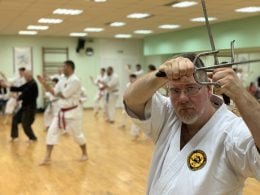
There are 2 types of Sai used in the system, Tsuujo no Sai and Manji Sai. This weapon is the supporting mainstay of Ryukyu Kobujutsu and attracts 8 kata to the syllabus. This weapon is not the result of agricultural creativity as commonly written. Records from China prove its original existence although in a much more elongated form. The weapon is metal and of the truncheon class with its length dependent upon the forearm of the user. When held it should be about 3cm longer than the forearm and generally Sai are used in pairs. Advanced Sai uses 3, with one held in the belt behind ready for, and used for throwing. The tang is of the Korean classification and the pommel is variant to round, square or multi angled types much dependant on the emphasis of the makers usage. The basic holding manner “Honte-Mochi” (Natural) and “Gyakute-Mochi” (Reverse) is prevalent with basic Sai whereupon the advancement to “Toku-Mochi” (special grip) is introduced. This brings the usage and actions of the Sai into the same family as Tonfa and Kama. The Manji Sai which was made by Shinken Taira has a half reversed tang looking much like a swastika and a pointed pommel end denoting Sensei Taira’s preference to a stabbing motion instead of the smashing techniques dominant with the Tsuujo Sai.
The efficient use of the weapon is much reliant on the dexterity of the practitioner with his thumbs, which the tang is balanced and rotated on along with the loosening and tightening of the grip from the small finger for striking and consolidating power. The early use of the weapon makes the user appear stiff and robotic but as the training advances the flow and unity with body movement becomes ever more apparent. Sai is the practice of “Shuto” in empty hand and emphasizes the need for “Koshi no Chikara” (Hip power) and “Suri Ashi” (sliding movement). The importance of body movement and good footwork is ever more apparent as the weapon is of a smaller classification than Bo. Advanced practitioners must learn to throw the Sai, a difficult requirement in view of the weight. The Sai explores the weakness of Bo, thus making Bo-jutsu stronger.
|
|
Tonfa
|
There is in principal only one kind of Tonfa although the shaft varies in shape from round to rectangular. History has also shown the butt ends to be pointed but this is extremely rare. The weapon attracts two kata in the Ryukyu Kobujutsu syllabus but because of its exposure with the police in the baton form it is a very popular weapon to practice with. The weapon is used in pairs and is of wood, again red oak or white oak preferably in keeping with the Bo. The length of the weapon is also the same requirements as the Sai, about three centimeters past the elbow when gripped. The weight like the Bo is paramount to the efficient usage of the weapon. Too light and it lacks power in Kumite, too heavy and the techniques lack speed and become ponderous. Again like the Sai there are three grips, Honte-Mochi (Natural), Gyakute-Mochi (Reverse) and Tokushu-Mochi (Special grip). The latter is not commonly used but is very effective and relates strongly to the techniques of Kama. The usage is prevalent in the kata Yaraguwa. Tonfa is the practice of Uraken (back fist) and Hiji waza (elbow techniques) in open hand fighting. Good body movement like the Sai can make this weapon formidable, combining the speed it needs and generates along with the skilful footwork for evasion and attack. Although there are stories of Rice millstone grinding implements and horses bridles etc. as being the origins of this weapon, these are merely coincidental. The weapons origins can clearly be traced back to China and be found in Indonesia and surrounding geographical locations. |
|
Kama
|
The bladed weapon of the Ryukyu arsenal, this weapon brings to the practitioner the feel of steel and the hint of fear a live blade gives. Used, as a pair there is one style of Kama with varying sizes of blade length and shaft size. The corner of the blade to the shaft should have a groove cut into it for catching the Bo and other weapons without the blade digging into and getting stuck into the attacking weapon. The weight of the shaft is dependent upon the strength of the user and should be tapered to the butt end with increasing thickness. This allows for ease of catching and sliding when changing grip. The blade should add sufficient weight to ensure it is the heaviest point in the weapon. This also allows for ease of usage. The length of the weapon should extend to about 3cm passed the elbow when held in reverse grip. The handling of the weapon is the same as the Sai with the following grips, “Honte-Mochi” (Natural), “Gyakute-Mochi”(Reverse) and “Tokushu-Mochi”(Special grip). Kama is the practice of “Kuride” and “Kakede” (hooking and gripping) in open hand technique. The Ryukyu Kobujutsu syllabus has three kata of Kama, which emphasize body unity with the weapon to obtain power along with demanding footwork. The dexterity of the fingers is paramount to the changing grips the weapon affords and needs in kumite. Most students commence with wooded Kama to ensure safety and acclimatization before moving to the more demanding live blades. This weapon known as the sickle in the west has a derivative from the farming implements. |
|
Tekko
|
Legally the most controversial of the Ryukyu weapons the Tekko is the smallest weapon, bringing the exponent closest to open hand techniques. The term “knuckle duster” creates images of darker methods of fighting but in actuality attacks clearly defined points vulnerable to the taste of metal. The Tekko should be made to the width of the hand with anything between one and three protruding points on the knuckle front with protruding points at the top and the bottom of the knuckle. They can be made of any hard material but are predominately found in aluminium, iron, steel, or wood. Due to the size of the Tekko the techniques are of the open hand family. The Ryukyu Kobujutsu syllabus has one kata, which is a combination of the “Naha”, “Shuri and Tomari” feeling combined. The kumite focus on attacking the bony areas of the body such as the wrist, elbow, collar bone, ribs, and ankle. On impact this slows done the opponent drastically and allows for the quick changes of angle and height so apparent when studying Tekko. Gripping techniques prior to and at the time of “Zanshin”teach the exponent the emphasis on pressure points, which the Tekko takes great advantage of due to its structure. Muscle and bone have to succumb to its efficient design and usage. This weapon is undoubtedly not a farming implement and was clearly design for the purposes of combat. |
|
Nunchaku
|
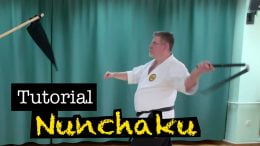
The most controversial of the weapons of the Ryukyu but in essence the least properly explored. There are three types of this weapon taught in the Ryukyu Kobujutsu syllabus, the 2 section, 3 section and the 4 section. Made preferably of red or white oak, or a heavy wood, the sections are tapered from the chord end (2.5cm) to the predominant strike end (3.3cm). The shafts vary from octagonal to round in shape and the weight is dependent on the strength of the user. Again too light and there is no power, and too heavy and the movement is slow and ponderous. Traditionally this weapon is not used in pairs, as the actions of the one should be sufficient. The grips are similar to that of the Sai in name, Honte-Mochi” (Natural), “Gyakute-Mochi”(Reverse) and Tokushu-Mochi”(Special grip). The special grip falls into “Ippon-Tsuki” (single thrust) and “Tatami-Tsuki” (folding thrust). Nunchaku belongs to the family of Bo and is known as the “portable Bo”. History has not endowed this weapon with traditional kata as shown by the content of those handed down. They are by design training kata to enable better handling and combination work. The essence of the weapon is the kumite, exploring distance, angles and footwork. Impact should be on the tip of the weapon or it will bounce back on the user. Whilst it is noted that there is a farming implement of the Nunchaku design, it should be pointed out that again China was using this weapon concept long before it was recorded as a Ryukyu weapon. |
|
Tinbe-Rochin
|
This weapon is the most glamorous of the Ryukyu system and exudes a feeling of history long gone. The usage however is more akin to a combination of Zulu fighting and European sword and small shield fighting. The Tinbe (Shield) can be made of various material but is commonly found in vine or cane, metal, or for presentation, in turtle shell. The shield size is generally about 45 cm long and 38 cm wide. The Rochin (Short spear) is cut with the length of the shaft being the same distance as the forearm to the elbow if it is being held in the hand. The spearhead then protrudes from the shaft and can be found in many differing designs. The favored style has an expanded middle section before the point, which is twisted upon insertion to make the wound larger. The weight of the blade is critical for the spear usage, which is swiveled between the fingers to use both ends, smashing with the butt end and stabbing with the blade end. The techniques are circular to avoid too much direct contact on the shield and the short spear is predominantly used in an upward stabbing motion, piercing armour under the rib cage, armpits, and throat. Good knees are essential for the kumite along with a proficient understanding of Ukemi. The Ryukyu Kobujutsu syllabus has one kata, which exuded posturing, speed with agility, and balance. The techniques of the Tinbe-Rochin are unique to shield and spear usage. Clearly the origins of design and usage bear little resemblance to agricultural needs. |
|
Surujin
|
This weapon is taught as the last in the Ryukyu system of the classical eight weapons. Found in two kinds, Tan Surujin (short) and Naga Surujin (long) the lengths are about 150-152 cm and 230-240 cm respectively. It is a weapon with the essence of concealment prior to use, which can extract a substantial price from the victim. Traditionally found with a bladed instrument at one end and a weighted end at the other, the Surujin techniques are very akin to those of the Nunchaku. For kumite training the cord is usually made of leather allowing more speed and agility. Kata however tends to be demonstrated with a chain link Surujin to emphasize the potential in the weapon. The difficulty in usage is the control of the swing and the awareness of the length required in respect of the fighting distance. The hips need to be centrally fixed with a low center of gravity and the swing should be through the arm to the shoulder without moving the head. The recovery from the swing is dependent on the dexterity of the user, as it is critical to the final attack before the stab. Historically this weapon is very prevalent and can be found attached to a weapon or used separately. It is undoubtedly a weapon designed for warfare and not for agricultural usage. |
Posted on January 7, 2009 - by tokugawa
The kata of okinawan Isshinryu
|
Posted on January 5, 2009 - by tokugawa
The animal techniques of Uechi ryu (2)
| KICKING TECHINQUES
Kicking in Uechi-ryu karate differs from many other styles. The front-leg snap kick is the only kick used in the katas brought from China. It is found in every kata of Uechi-ryu except Sanchin, which contains no kicks. The front-leg kick, like the lead hand punch, is the first line of defense, as it is the closest technique to the opponent. It can be executed quickly against an incoming attacker. This approach exemplifies the “defense only” philosophy of Uechi-ryu karate. The snapping of the kick is an important source of power since the hips cannot be used in the front-leg kick as effectively as with a rear-leg kick. Front kicks in traditional Okinawan kata are aimed at the middle (chudan) or lower (gedan) areas of the body. Kicks that are normally performed by most systems with the ball of the foot, sokutei, are executed in Uechi-ryu karate with the tip= of the big toe (sokusen). Kicks with the ball of the foot do not exist in this system. Sokusen geri is the only kick in the original three katas brought from China. Like the shoken fist, sokusen kicks emulate the destructive effect of a tiger’s teeth. These techniques deliver an enormous amount of power to a small area. Deeper body penetration and more damage to the area attacked are the results. Any part of the body is a potential target for sokusen. Newer students should practice kicking with the ball of the foot for their own safety. Preparing the toes for kicking is an arduous process. First the muscles in the toes must be developed so they can be flexed into the proper position. This can take several months. Second, the tip of the toe must be conditioned to take hard contact. This takes several years. To form sokusen, pull your toes back toward your foot, tightening all toes together. Here are six methods for strengthening sokusen technique:
OPEN HAND TECHNIQUES Nukite is an advanced technique that is very prevalent in the Uechi-ryu system. It is found in all eight katas. Like a shoken punch and sokusen kick, it delivers the primary point of impact to a very small area. Attacking pressure points and soft body parts with this specific strike allows you to inflict maximum damage using little movement. Therefore, body size and strength are not a major factor for effectiveness. When you form your hand for a nukite strike, tighten all four fingers together and place the thumb firmly against the ridge of the hand. When you tighten your fingers, they will naturally curve in slightly. It is important not to let the fingers bend backward on impact. The name of the striking weapon changes as the hand is bent to apply fingertip strikes from different angles, such as kakushiken and koken. To form kakushiken, bend all four fingers where they join the hand and support them by placing the thumb at the base of the forefinger. Kakushiken is executed with the fingertips, in a forceful downward strike, like the beak of a desperate bird defending its life. Snapping the elbow and wrist increase the power. The targets of the crane’s beak are the neck, throat, and soft area behind the collar bone. Kakushiken, an advanced and deadly technique, is found only in Sanseryu kata. Koken is formed the same as the kakushiken strike but is applied differently. A large swinging motion is used to deliver this downward strike. To increase power in this technique, a scooping action is added at the point of contact. The targets of this strike are the groin and nerves in the pelvic area. This technique is effective against a grab from behind. Uechi Kanbun told a story to Shinjo Seiyu about a Chinese martial artist who visited him and discussed an interesting conditioning exercise emulating a crane. The man dumped a small bag of rice on the dojo floor. He picked the rice up, one grain at a time, with the fingertips, much in the way a bird would pick them up with its beak. As the grains of rice disappeared, the strength of the man’s developed fingertips became apparent. The visitor explained that in a fight he could apply his pecking and pinching techniques to the veins in the arms of his opponent, causing deadly internal bleeding. Uechi became intrigued with this idea and stood up, directing the man to demonstrate the technique on him. Several attempts were made but none were successful because of the extreme development of Uechi’s arms. Arm conditioning (kote kitae) had rendered the crane technique ineffective. The degree of conditioning necessary to develop these advanced striking techniques are a major hindrance in modern use. Extensive use of the Okinawan conditioning device, makiwara, is not as prevalent in the West as it is in Okinawa. A well-conditioned and highly refined animal strike may be your only saving grace when you face a deadly opponent of greater strength or determination. About the Author: Based on Secrets of Uechi Ryu Karate and the Mysteries of Okinawa (1996) by Alan Dollar and published by Cherokee Publishing. Information: Alan Dollar, Cherokee Publishing, 1001 Fitzuren Rd., Antioch,CA 94509 510-778-4400, fx 510-778-4468 email: Cherokee@aol.com> |
![]() The big toe kick(sokusen) of Uechi-ryu karate emulates the tiger’s bite. Sensei Shinjo Kiyohide demonstrates the penetrating effects of this effective technique on his son Shuichi, of Kadena, Okinawa. Developing the toesfor kicking is an arduous, painstaking task requiring years of dedication. An old tire makes an ideal target.
To execute a nukite
Kakushiken (left)
|
Posted on December 26, 2008 - by tokugawa
Chojun Miyagi on technique
‘Do not strike others’ ‘The principle is the peace without incident’ Chojun Miyagi was born April 25th 1888 in Higashi-Machi (Naha-shi) Okinawa of a wealthy family who’s business was import/export primarily pharmaceuticals. Originally Chojun Miyagi was born as Miyagi Matsu however his name was changed to Chojun at the age of 5 by his uncle whom adopted him after the death of his father in 1893. His family owned two ships which made regular trips to mainland China, placing them among the wealthiest families in the area and enabled a young Chojun Miyagi Sensei to travel to China to study the style of his instructor and develop the style of Karatedo we call Gojuryu today. However his original Martial Arts training started with his neighbor Ryu Ko Aragaki (one of the very few fighters ever to beat the legendary Choki Motobu) at 11 years old. Ryu Ko ragaki Sensei, before moving his family to Taiwan, later introduced him to Kanryo Higaonna, and he began training at the age of 15 in the fall of 1902 after fulfilling a host of chores (the traditional way of being accepted by an instructor).
After years of training with Higaonna Sensei, Miyagi sailed to China in May of 1915 in search of his Higaonna’s teacher. This was one of three trips he made to China during his lifetime. Upon his quest he studied Chuguko Kempo (Chinese Fist) in Fouchow, Fukien Province, from 1915 to 1917. He returned to Okinawa due to the death of Higaonna Sensei. In early 1917, Kanryo Higaonna Sensei died (at Nishiishin-Machi, 2-chome, Naha Okinawa). Chojun Miyagi Sensei paid for his funeral.
When he returned to Okinawa, he began to teach his Karatedo at a number of places in and around Naha, and to lecture and demonstrate throughout Japan Miyagi-Sensei subjected the art of Naha-te, as received from Kanryo Higashionna, to scientific examination. He studied the basic Go (Sanchin) and the six rules and created the Ju (Tensho) form, combining soft and hard movements. He also organized the auxiliary movements to strengthen the body through calisthenics. He organized these exercises in preparation for practicing the classical Kata. It can be said, he formulated the theory for the practice of Karatedo and organized it as an educational subject, an art of self-defense, and as a spiritual exercise. From the old Chinese book Wu Pei Chih (Army account of Military Arts and Science) published in 1636, Miyagi took the expression Gojuryu for the name of his school as it appears in the sentence: The successful methods required both give and take (Go and Ju). Miyagi Sensei was the first instructor to officially give his style a name in 1927 apart from the city in which it was practiced (See Historical review of Gojuryu), and organize a school of Karate. Miyagi often used the slogan Nanji Kyokuden, meaning to “apply all Strength, be determined in everything that one does; defeat is not the end; losing is not the end of everything.” He was called the last great samurai warrior of Okinawa because of his legendary strength and skill as well as his intense dedication to the martial arts.
In 1929 Gogen Yamaguchi invited Mr. Miyagi to visit Japan and he later named Mr. Yamaguchi the leader of the Gojuryu schools in mainland Japan. That same year 1929) he was named as Shihan of the Okinawan Police and of the Naha School of Commerce (The Municipal Commercial High School – the general education program of Okinawa). Chojun Miyagi was named Karatedo Division Chairman (Chief) of the Okinawan Prefecture Athletic Association in 1930 and became a permanent officer of the Dai Nippon Butokukai (Japan Martial Virtues Association).
Chojun Miyagi Sensei worked hard to spread Karatedo throughout Okinawa and mainland Japan, and to earn Naha-te a status equal to that of the highly respected Japanese martial arts of Judo and Kendo. To achieve this he traveled frequently to mainland Japan where he was invited to teach Karatedo at Kyoto University and Ritsumei Kan University. In 1933 Karatedo was registered at the Butokukai, the center for all martial arts in Japan. This was a milestone for Karatedo as it meant that it was recognized on a level with the highly respected martial arts of Japan. On March 23, 1934, Chojun Miyagi wrote the document Toudijutsu Gaisetsu (‘An Outline of Karatedo’) very rare to find and very technical on the almost spiritual training associated with Karatedo.
During this time he also becomes a permanent officer of the Dai Nippon Butokukai (Great Japan Martial Virtues Association).By 1936 Mr. Chojun Miyagi is truly recognized by the Government of Japan with being awarded the medal for “Excellence in the Martial Arts” from the Japanese Ministry of Education. That same year he went to train at the Chinese martial arts in Shanghai at the Seibu Dai Iku Kai or Great Gymnastic Association – Pure Martial Spirit. On May 5th, 1937 – Chojun Miyagi Sensei performed Kata at the Butoku Sai for the Dai Nippon Butoku-kai. Following what is now known as the Meeting of the Masters, Mr. Miyagi along with others who attended formed the ‘Great Japan Martial Arts Karatedo Teachers Association’ or ‘Dai Nippon Butokukai Karatedo Jutsu-Kyoshi’(1937). The first ever awarded in Japan. After returning to Okinawa Miyagi Sensei, now teaching in his Dojo again as well as teaching Okinawa school Children, creates the Kata Gekisai Dai Ichi (1) and Ni (2). Chojun Miyagi’s students primarily studied four Kata: Sanchin, Sesan, Seiunchin and Tensho. These Kata are called the Kaishu forms but the Kata Sesan and Seiunchin were actually considered the training Kata of Gojuryu. These are very important Kata and must be thoroughly studied to understand Gojuryu. As of Before the Second World War, Chojun Miyagi traveled widely and was involved in many projects to spread Karatedo throughout mainland Japan and the rest of the world. However, from 1948 until 1953 he remained in Okinawa. Before the war he had been dedicated to his own training and research, to further develop the art of Gojuryu Karate, but his purpose in life had now changed. He was intent on passing on Gojuryu, and the “gokui” (secret principles) of Gojuryu to the next generation. For reasons mostly pointing to WWII, may students of Tsuboya-cho (a district of Naha) garden dojo returned for training in in 1951. As well, new students once more began to enroll.
Naha’s Central Police buildings were rebuilt near the Butoku-den, which was torn down in the late l980’s. A bronze bust of Chojun Miyagi was put up in the Butoku-den and was moved to the Naha Police Headquarters in 1987. Chojun Miyagi Sensei instruction was not limited to physical training. Miyagi Sensei also lectured his students on history, culture, society, human relations as many senior Sensei of today do. During these ‘sessions’ Chojun Miyagi Sensei would teach the kata (forms) in great detail and explain the “bunkai” (kata applications) thoroughly. Chojun Miyagi dedicated his whole life to karate. He was responsible for structuring Naha-te (which he later named “Gojuryu”) into a systematized discipline which could be taught to society in general. This teaching system which he formulated enabled Karatedo to be taught in schools for the benefit of the young, and to reach vast numbers of people throughout the world. However, his private teaching at his home remained strictly in adherence to the principles of his teacher, Kanryo Higaonna, and his teacher before him, Ryuruko. Miyagi never awarded anyone a Black Belt. He was in the process of formulating requirements for the Black Belt however he died before he completed this. He had not conceded a sucessor at the time of his death. Leaving an unprecedented mark in the world of Karatedo and from his famous Garden Dojo and enough legendary students to carry his name into the history books of Martial Arts as the ‘Master”. Jin’an Shinzato Sensei (aka ‘Jiru’), an exceptional talent, was the probable successor to the Goju school in Okinawa, he was tragically killed during the Second World War. It is generally an excepted theory that Shinzato Jin’an Sensei would have been the obvious successor to Chojun Miyagi Sensei had not his death. Later, after the war, Meitoku Yagi Sensei was awarded the training uniform (Do Gi) and Belt (Obi) of Chojun Miyagi Sensei by his wife and daughter. Chojun Miyagi passed away October 8th, 1953, leaving his family of 10 children, wife and a great legacy behind. He dedicated his entire life and fortune to Karate. He predicted that during the twentieth century Karatedo would spread throughout the world. Today we can see |
Posted on December 26, 2008 - by tokugawa
Sai jutsu
| The Stories and Practice of the Okinawan Sai
by Saiby Toshihiro Oshiro and William H. Haff Any penetrating review of Okinawan weapons history is a mixture of hyperbole and fact.
Most modern martial arts students have been taught that Okinawan kobudo developed as a result of the Okinawan samurai being stripped of their weapons at two different points in their history. But a review of these incidents shows that our current view of the roots of Okinawan kobudo might be based on misconceptions.
The first time that the Okinawan samurai’s weapons were supposedly confiscated was during the reign of King Shoshin (1477 – 1526). While it is documented that King Shoshin ordered his provincial lords, or aji, to live near his castle in Shuri, many historians no longer believe that he totally disarmed his ruling class. A famous stone monument, the Momo Urasoe Ran Kan No Mei, which is inscribed with the highlights of King Shoshin’s reign, talks about the King seizing the aji’s swords, and how he amassed a supply of weapons in a warehouse near Shuri castle. But some Okinawan historians now interpret that King Shoshin was actually building an armory to protect his ports and prepare for any potential invasion by wako, or pirates, not that he was stripping the Okinawan samurai or the general population of their weaponry. The second time that the Okinawan samurai were purportedly disarmed was after the Satsuma invasion of 1609. But documents have been recovered that state that the Satsuma outlawed the ownership and sale of firearms, all the Okinawan samurai of the Pechin class and above were allowed to keep those muskets and pistols that were already in their family’s possession. There is further documentation that in 1613 the Satsuma issued permits for the Okinawan samurai to travel with their personal swords (tachi and wakizashi) to the smiths and polishers in Kagushima, Japan for maintenance and repair. From the issuance of these permits, it is logical to infer that there were restrictions on the Okinawan samurai carrying their weapons in public, but it is also clear evidence that these weapons were not confiscated by the Satsuma. Based on this misconception that the Okinawan samurai were stripped of their weapons by the Satsuma most modern martial arts students are taught that Okinawan kobudo developed because the Okinawans turned to farm implements for their self-defense and training. When we consider the sai specifically we can see that the plausibility of this common myth is significantly strained. Sensei Toshihiro Oshiro, long time practitioner of Yamanni-Chinen Ryu Bojutsu and the Chief Instructor for the Ryukyu Bujutsu Kenkyu Doyukai – USA, says that he has never found any evidence in his own extensive research to support the theory that the sai was used as a farming tool. Nor has he been told that by any of his teachers. He asserts that the sai has always been a weapon. If this is true, then where and how did the sai originate?
One story suggests that the sai made its way into Ryukyuan history by following the path of Buddhism, migrating from India to China to Okinawan. The shape of the sai were designed in the image of the human body; after the monks who carried them for protection. While there is little way to ascertain the veracity of this story, it remains an interesting projection. Another, more modern story that martial artists often hear is that the practice of the sai originated with the Okinawan police force who carried the sai as their personal “side-arm” to control crowds and apprehend criminals. This story gains credibility because one of Okinawa’s leading sai practitioners was Kanagushiku (Kinjo) Ufuchiku, a highly regarded police captain who lived from 1841-1926. But if the sai was the required weapon for the police, Sensei Oshiro believes that there would be some evidence in recorded laws or regulations from the previous century in Okinawan history. To date Sensei Oshiro says that he hasn’t been able to find any proof in his research that supports this story. He thinks that the sai had a much wider following in the Okinawan martial arts community.
As we mentioned above, while the Satsuma did not confiscate the personal weapons of the Okinawan samurai class, there were tight restrictions imposed on their rights to carry their weapons in public. The Okinawans increasingly relied on “kakushi buki” or the practice of concealed weapons for their self-defense and the defense of their family and property. Sensei Oshiro maintains that the sai were one of the prevalent weapons used for this purpose. The Okinawan samurai would often carry as many as three sai concealed in the sleeves of their kimono and in their obi. These hidden sai were typically shorter than the modern sai used today, with straight wings rather than flared so as not to snag on clothing when they were being drawn. When the Okinawans felt that they were in danger of imminent attack they would immediately strike with or throw their concealed weapon. Since throwing the sai was a common technique, the Okinawans routinely carried more than one sai.
Many modern martial arts practitioners assert that because of their winged structure they were used to block bo. While these assertions might be technically feasible, the range and momentum generated by the longer weapon would make sai a risky defense. Sensei Oshiro believes that sai were generally used in a “first strike” or surprise movement. The winged shape of the sai increases it versatility and enables a wide variety of striking techniques. There is also evidence that use of the sai was integrated more widely into the Okinawans’ martial arts practice and used to augment other disciplines. Many Okinawan martial arts reference books speak of the sai being used for “hojo undo” or endurance training. While it is possible that the native martial artists used these heavy sai for fighting, it is more probable that they were training tools used for developing arm and wrist strength. Similar to swinging a weighted bat in baseball batting practice, the benefits from this type of training would improve not only their sai strikes, but carry over into their karate and bo training as well.
The sai have been practiced for many years in Okinawa, but it was very individual practice. Because the sai were used primarily for self defense, they were not systematically taught as a separate martial arts style. Each person would have their own places to carry and hide their sai and developed their own favored techniques. Thus we find that sai does not have as documented a tradition in Okinawan martial arts culture as either the bo or karate. The “traditional” sai kata practiced today are of relatively recent invention. If the above comments are reasonably “accurate”, where does that leave modern martial artists as they consider their practice of the sai and its place in Okinawan kobudo tradition? While the sai do not have as long a kata’s history as the bo Sensei Oshiro feels that they are very beneficial for modern budoka to study. Starting with basic techniques, today’s practitioners can study how to grip the sai, how to use their wrist in flipping the sai and developing a stronger strike. Modern students should spend long hours building up their striking speed and capabilities. As Sensei Oshiro constantly admonishes his own students, “when you swing the sai, you should always cut the air. Swing fast, but never let your arms move outside the scope of your body. Basically, you should always try to reach longer when you swing. In advanced forms you should recoil after your strike, hiding your sai and preparing for the next movement.
With kihon movements for the sai, it is perfectly appropriate for beginners to move each arm sequentially, first one side then the other. But in more advanced technique both the right and left sai should be used in tandem, flowing from one “waza” to the next. “Of course”, says Sensei Oshiro, “when you complete a certain combination or series of techniques, you must use kime, or focus”.
Consistent with the sai’s history as “kakushi buki”, modern practitioners should try to initiate their strikes right from where their hands are without too much setting or winding-up. Also they should not let the tine of the sai separate from their forearm as they prepare to strike, giving away the position of the sai and telegraphing their intended movement to their opponent. Because of the sai’s short range, footwork is critical to the proper use of this weapon. Learning how to move in and out dynamically and how to change sides and angles will provide the modern sai student with many hours of challenging practice. Footwork, hip movement, and the upper body should all be integrated for maximum power and effect. Well founded sai kata should incorporate this elements. Look for a combination of basic and advanced technique in your katas. The art and practice of the Okinawan sai has a long yet murky history. Inspite of the fact that our current understanding of the origins of the sai is not definitive, the practice of the sai can provide today’s martial artists with a chance to look back to the “old ways” and flavor their modern training with a taste of earlier Okinawa…. The research for this article is based on Sensei Oshiro’s own experience, the oral traditions passed along by his teachers, and from the following texts:
Okinawa No Rekishi by Eisho Miyagi (1968) Okinawa Ken No Rekishi by Keiji Shinzato, Tomoaki Taminato, Seitaku Kinjo (1972) Shijitsu To Dento O Kokoru Okinawa No Karate-Do by Shoshin Nagamine (1975) Okinawa No Dento Kobudo by Masahiro Nakamoto (1983) Taidan-Kindai Karate-Do No Rekishi O Kataru by Shinkin Gima, Ryozo Fujiwara (1986) Karate No Rekishi by Tokumasa Miyagi (1987) Ryukyu Ohkoku by Kurakichi Takara (1990) Ryukyu Bojutsu by Katsumi Murakami (1992) Ryukyu Oh-koku No Jidai by Okinawa Kokusai Daigaku Kokai Koza Iinkai (1994) This article is taken from www.oshirodojo.com |
||||||||||||||||||||


Although, Jigoro Kano (founder of Judo and the Kokokan) began visiting Okinawa in 1927, he was so impressed with Miyagi Sensei, he invited him to Japan in 1930 and 1932 to demonstrate at several meetings. It was at one of these meetings that one of his senior students, Jin’an Shinzato was asked which
One month later in April, 1934 – Yokoku Jihosha invited Chojun Miyagi Sensei to Hawaii to lecture and teach until February, 1935. Chojun Miyagi on Thursday, May 3, 1934 aboard the NYK steamship. The trip is also supported by business-men 
Chojun Miyagi Sensei had four boys and five girls. Miyagi Tsuru was the oldest daughter and first born. Master Miyagi taught at his home, outside in his Garden Dojo. But he didn’t teach regularly outside his own personal students other than his municipal duties (Police and education). He would occasionally goto the Butoku-den in Naha (The Butoku-den was one of the few buildings that survived the World War II battles on Okinawa).