Posts Tagged ‘Kumite’
Posted on January 4, 2009 - by tokugawa
Prearranged fighting (kumite)
Kumite
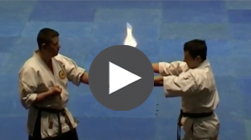
| Kumite (sparring) is form used to practice techniques of kata, under more realistic conditions, in which by prearrangement between participants, one applies offensive and the other defensive technique. There should be no corrupting influence on one’s kata from sparring practice. (Gichin Funakoshi).Tsunami dojo uses three different kinds of kumite. | |
| Kote kitae
This is very important part of every training. With your partner you exchange alternatively some basic attacking and blocking techniques. Most known drill is called “sanbon uke”. Goal of this kitae exercises is to learn how to contract your muscles during fight and also to learn where to receive attack. All this you achieve by practicing basic techniques. |
![]() |
| Ipon kumite
Ipon kumite, also known as “yakusoku kumite“, means “start-stop sparing“.These are simple offense – defense prearranged sparing techniques. We use ipon kumite for beginners, so that they can practice basics of self-defense, before they decide to advance in karate more seriously. We use up to 12 ipon kumite techniques, which were all taken from various katas – fist punch, soto shuto, sagurite (hente), elbow, kick, knee, throw, elbow lock, head manipulation, strangulation, grabbing of testicles… This will help begginers to better understand advanced applications of kata. It is useless to practice advanced fighting techniques (kata), without basic knowledge of self-defense. |
![]() |
| Renzoku kumite
Renzoku kumite – continuous sparing. When practicing kata it is very important to understand movements within it. If you don’t think about application, then your kata is dead – just a simple dance, not karate. Renzoku kumite practice is reserved for advanced practitioners. This exercise is used for practicing moreadvanced and hidden (kakushite) techniques of certain kata, like escaping techniques, throwing, joint-locking,… |
![]() |
Posted on December 26, 2008 - by tokugawa
Kata, bunkai, tegumi… (5)
LETTER 5. - About kata practice.
It is hard to disagree with most of what has been written about this subject but I have a few comments that I hope will be helpful.
I agree with Shogiki’s comment about having “faith” in practicing the kata. Faith is defined as hope in what is not seen. All of us that practice the kata without knowing the complete meaning of kata are practicing faithfully with the hope that what we are practicing will produce the results that we have predisposed in our mind. I think that this will satisfy as a definition of kata.
There are so many levels of understanding kata that you cannot limit yourself to one meaning or one by product of your effort. Again that faith word is important. All of us who have trained for some time without having to actually use some of the movements that we envision that will work are going forward on faith that the techniques will be there to provide us safety, health and well being not only form physical attack but from ourselves.
Perhaps this is what kata was designed to do.
The concept of kata is an enigma as to it’s origin and original purpose. Many followers of the practice of kata have continually preached it’s importance but only have faith that the kata practice produces what we are looking for.
So why was kata created ? The preservation of techniques, a method of teaching techniques in an orderly fashion, a method to develop the body equally or a method of teaching the body to move instinctively ? I think it is all of these but the latter is the end result.
Based on 39 years of kata training, which over half of that was on faith alone , I have found that the purpose for me is training the body to move instinctively. To achieve this instinctive movement does not necessarily require that you have the understanding of the bunkai or principles of movement but the more you mentally become aware of the purpose and methods the more effective the results are.
Does a beginner need to know the bunkai and principles of movement ? I have taught both ways. At first when I returned from Okinawa in 1971 I was so full of all the bunkai knowledge that is all I wanted to share with my students due to when I trained before going to Okinawa I had no clue of what bunkai was. After some months of trying to insure that “the” bunkai was taught as the kata was learned I found that the students would alter the movements of the kata to cause the effect of the bunkai and that is when I remembered my teacher stressing that there were many bunkai and not to change the kata movement to accommodate the bunkai movement.
Each kata movement has a purpose outside of the obvious and these movements are what teach the instinctive ness. If you have one bunkai in mind and do not concentrate on the perfection of movement then you will not develop the instinctive mind.
The focus should be on the perfection of the movement and the applications flow from the movement and creativity of the mind or the spontaneity of the situation.
“Faith without works is dead”.
Gumbatte Kudasai
Dan
Posted on December 26, 2008 - by tokugawa
Kata, bunkai, tegumi… (6)
LETTER 6. – About Tegumi.
I think that many people are off on a tangent concerning grappling, Te Gumi, Toide, etc., etc. etc. when analyzing Okinawa karate. I understand the need some people have when they consider having to grapple with someone and the Okinawan kata takes provides for this but not in the way that is being represented. Okinawan karate focuses on the basic understanding o
- Get out of the way of an attack. Even if you are grasped you use movement to escape not grappling.
- Parry the attack as you move to give yourself the added protection from the attack and to create an opening to counter attack.
- Attack the vulnerable points on the body as the openings are created through movement.
Yes, there are a few techniques in Okinawa kata that teach you how to block and grab as you apply a strike to the opponent. There are techniques in the kata that teach you how to react if your attack has been blocked and grabbed and techniques that teach you how to react when seized by the opponent but these are minimal when considering the vast number of techniques that are describe in 1 to 3 above.
My teacher on Okinawa taught four techniques against being grabbed. He stated that he only thought he would be grabbed in four ways. I thought about the many ways someone could grab you but the teacher said he only needed four because he believed that he would prepare himself to be only grabbed in the four methods that he could not guard against. Go through the kata and list how many ways someone can seize you. It is not many than four. You only have an arm, upper front body, upper back body and shoulders to defend. If someone tries an tackle you the kata of Okinawa gives you two choices or three if you count the one move in Uechi Ryu out of Seisan.
My point is that much is being made about a small number of techniques. It is true what someone said on the CD, if you are someone who practices atemi waza then kensetsu waza is something special and if you practice grappling then atemi waza is special.
IMHO the Okinawans specialized on 1 to 3 above.
And while I am espousing stuff that probably causes concern. Ikken haitsu is not an Okinawan concept. It comes straight from kenjutsu. The Okinawans simply say fight until there is no fight.
Gumbatte
Dan Smith